https://www.cdeide.com/the-ultimate-guide-to-sports-injury-rehabilitation-and-exercise-recovery/
Ankle sprain, a common injury among athletes and fitness enthusiasts, affects approximately 25000 people every day. Whether it’s intense competition on the sports field, or simple falls, unintentional “rolling” and “twisting” ankles in daily life, or even stepping on the wrong curb or falling on an uneven surface, all can trigger this annoying pain. Moreover, if not handled properly, it may lead to long-term inconvenience in movement.
Recognize ankle sprains
To gain a deeper understanding of ankle sprains, one must first understand their basic physiological and anatomical knowledge. The ligaments of the ankle joint tightly connect the bones through specific insertion points and starting points at the ankle, while ensuring smooth movement of the ankle joint, giving it balance and stability. Among them, the anterior talofibular ligament, calcaneofibular ligament, and triangular ligament are relatively common and important, playing a key role in stabilizing the ankle bones such as the talus, tibia, and fibula.
Once these ligaments are damaged, an individual’s ability to move, balance, and stability will be greatly affected. After a sprain occurs, it can be classified as grade I, II, or III based on the degree of ligament tension, strain, or tear. After injury, due to the possibility of extensive swelling, bruising, and pain, it is difficult to determine whether there is a fracture, subluxation, or dislocation solely based on physical assessment. At this time, taking X-rays is particularly important.

Treatment and rehabilitation of ankle sprain
Initial treatment
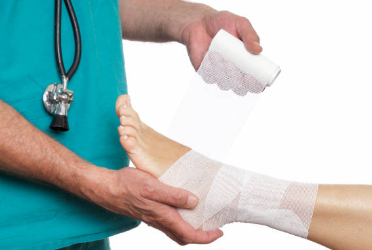
When ankle sprains first occur, the basic treatment methods are rest, ice compression, compression, and elevation (RICE). Rest can prevent further damage to the injured area; Ice compress can reduce swelling and pain, usually for 15-20 minutes each time and every 1-2 hours; Compression is achieved through tools such as elastic bandages to reduce swelling; Raising it will elevate the injured ankle above the level of the heart, promoting blood flow back. Meanwhile, depending on the severity of the injury, anti-inflammatory drugs and appropriate immobilization may also be required.
Rehabilitation core: Strengthening proprioception
However, the top priority of any ankle joint injury rehabilitation program is to develop a strategic plan that focuses on enhancing ankle proprioception. Ontological sensation, in simple terms, is the ability to know the relative movement position of limbs in space with respect to one’s own body. After an ankle injury, it is urgent to retrain and strengthen this ability. Because after injury, people often lose their perception of the ankle’s position in basic bodily movements and the environment it is in, which can lead to balance and stability issues. This not only affects athletic performance but also increases the risk of re injury.
Specific rehabilitation training methods
Balance training:
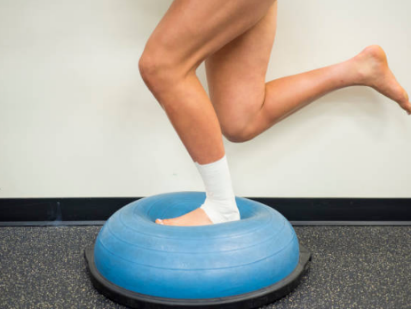
Stand on one foot: Start by standing on flat ground with both feet and gradually transition to stand on one foot. At the beginning of standing on one foot, you can hold onto a stable object with your hand to maintain balance. As your ability improves, gradually detach from the support and hold on for 30 seconds each time, 3-5 times per group, 2-3 groups per day.
Balance board training: Use a balance board to practice, stand on the balance board with both feet, try to control the body to maintain balance, gently shake the balance board left and right, front and back, for 10-15 minutes each time, 3-4 times a week.
Muscle strength training:
Heel lifting exercise: Stand with both feet, slowly lift the heels as high as possible, then slowly lower them, repeat 15-20 times per group, 3-4 groups per day. The difficulty can gradually increase, such as lifting the heel with one foot or tying sandbags around the ankle.
Ankle joint flexion and extension exercise: Sit on a chair, stretch your legs straight, lift your toes up, hold for 5 seconds, then extend your toes down, also hold for 5 seconds, repeat, 20-30 times per group, 3-4 groups per day.
Flexibility training:
Ankle joint wrapping: Sitting in a chair, one foot off the ground, slowly rotate the ankle clockwise and counterclockwise around the ankle, 10-15 turns in each direction, 2-3 sets per day.
Stretching exercise: Standing position, pull the heel of one foot as far back as possible, feel the stretch of the back of the calf and ankle joint, hold for 15-30 seconds, switch to the other side, 3-5 times per group, 2-3 groups per day.
Although ankle sprains are common, as long as we master the correct rehabilitation methods and actively engage in rehabilitation training, we can quickly restore ankle function and return to normal life and exercise. During the rehabilitation process, if the pain intensifies or other abnormal conditions occur, it is necessary to consult a professional doctor for advice in a timely manner.
https://www.cdeide.com/the-ultimate-guide-to-sports-injury-rehabilitation-and-exercise-recovery/